Chase Freedom Unlimited vs. Wells Fargo Active Cash: Which No-Fee Card Earns You More?
Last updated: July 2026
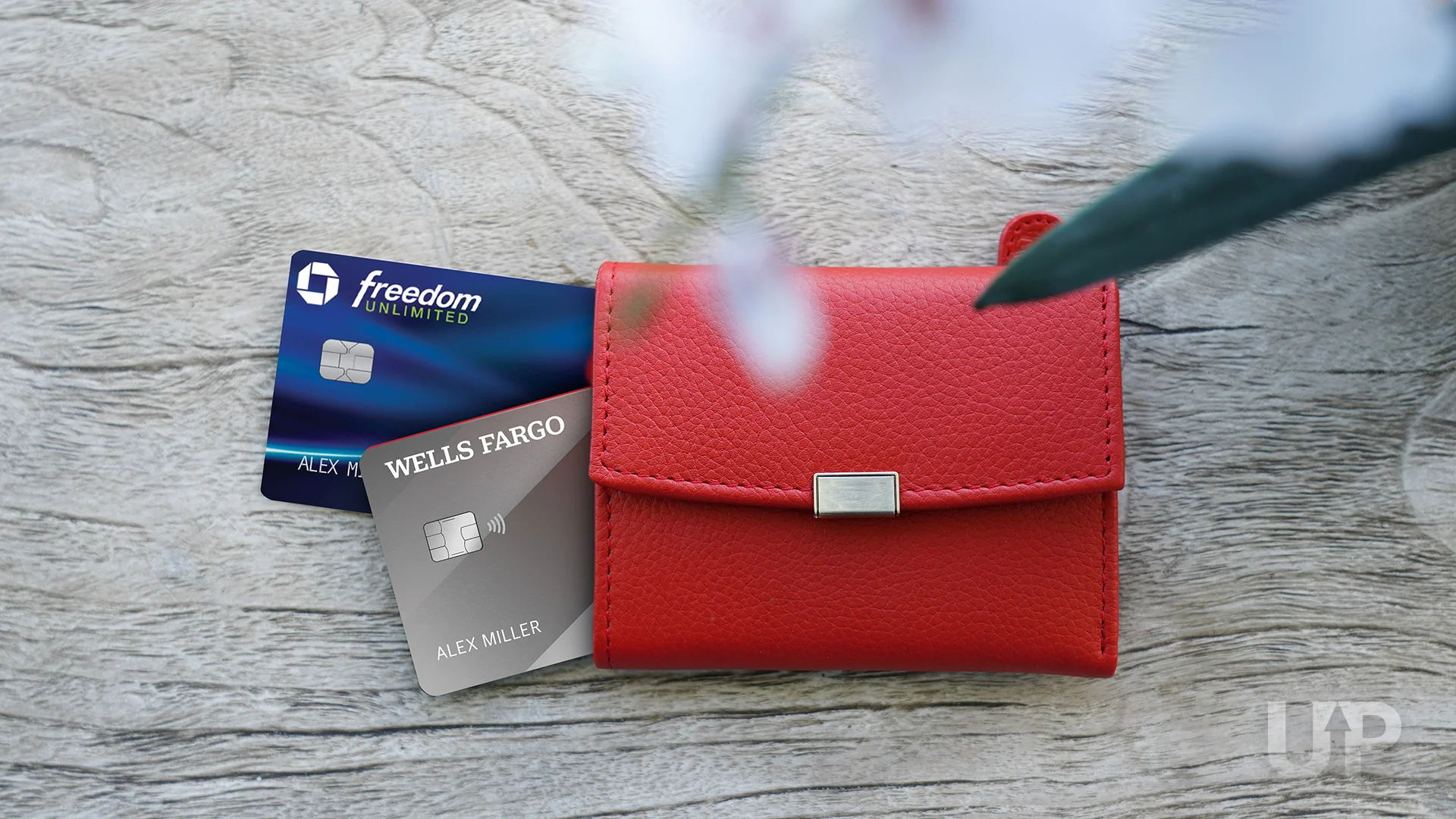
Both of these are $0-annual-fee cards with a $200 welcome bonus and a 0% introductory APR, which makes them look nearly identical at a glance. But their underlying rewards structures point in opposite directions: Wells Fargo Active Cash pays one flat rate on everything, while Chase Freedom Unlimited pays more on a few specific categories and less everywhere else. Which one actually earns you more money depends entirely on your spending mix — and the math isn’t always what the marketing implies.
Editorial note: We are not financial advisors. This article is for general informational purposes only and does not constitute financial advice. Card terms, rates, and offers are set by each issuer and change frequently — always confirm current rates, fees, and terms directly on the issuer’s official site before applying. This post may contain affiliate links; if you apply through one, we may earn a commission at no extra cost to you. That relationship never influences our analysis.
Quick Comparison Table
| Chase Freedom Unlimited | Wells Fargo Active Cash | |
|---|---|---|
| Annual fee | $0 | $0 |
| Base rate | 1.5% on everything else | 2% on everything, no exceptions |
| Dining (incl. takeout/delivery) & drugstores | 3% | 2% (same as base) |
| Travel booked through Chase Travel | 5% | 2% (same as base) |
| Welcome offer | $200 after $500 spent in 3 months (Chase has run limited-time offers up to $250–$300) | $200 after $500 spent in 3 months |
| Intro APR | 0% for 15 months on purchases and balance transfers | 0% for 12 months on purchases and qualifying balance transfers |
| Foreign transaction fee | 3% | 3% |
| Notable extra perk | Points convert to transferable Chase Ultimate Rewards if paired with a Sapphire card | Cell phone protection when you pay your phone bill with the card |
| Credit needed | Good to excellent | Good to excellent |
Wells Fargo Active Cash: One Rate, Zero Thinking
Active Cash’s entire pitch is simplicity: unlimited 2% cash rewards on every purchase, with no categories, no caps, and no activation required. It’s functionally identical in structure to the Citi Double Cash, though Active Cash pays the full 2% at the time of purchase rather than splitting it 1% at purchase and 1% at payment.
Beyond the flat rate, it includes a $200 welcome bonus after $500 in spending within three months, a 12-month 0% introductory APR on purchases and qualifying balance transfers, and cell phone protection when you pay your monthly phone bill with the card — a benefit that can be worth several hundred dollars a year on its own if you ever need to use it. The main drawback is a 3% foreign transaction fee, which rules it out as a travel card.
Chase Freedom Unlimited: Higher Rates in Specific Categories
Freedom Unlimited pays 5% cash back on travel booked through Chase Travel, 3% on dining (including takeout and eligible delivery) and at drugstores, and 1.5% on everything else — plus a limited-time 2% on qualifying Lyft rides through the Lyft app, running through September 2027. It carries the same $200 welcome bonus structure as Active Cash (Chase periodically runs limited-time boosted offers up to $250 or more, so it’s worth checking the live offer before applying), along with a longer 15-month 0% introductory APR on both purchases and balance transfers.
The card technically earns Chase Ultimate Rewards points rather than cash back directly, worth 1 cent each when redeemed for cash, gift cards, or Chase Travel bookings. If you also hold a points-earning Chase card like the Sapphire Preferred or Reserve, those points can be pooled and transferred to airline and hotel partners instead — a meaningful upside for travel-focused households, though not relevant if you’re just after straightforward cash back.
The Math: When Does Each Card Actually Win?
This is where the comparison gets interesting, because Freedom Unlimited’s 1.5% base rate is actually lower than Active Cash’s flat 2% on anything outside its bonus categories. That means Freedom Unlimited only pulls ahead once dining, drugstore, and Chase Travel spending make up a large enough share of your budget to offset the lower base rate everywhere else.
As a rule of thumb: dining and drugstore spending needs to be roughly one-third or more of your total monthly card spending for Freedom Unlimited to out-earn Active Cash’s flat 2% — and that’s before counting any travel booked through Chase Travel, which tips the math further in Freedom Unlimited’s favor if you use it.
A concrete example: someone spending $2,000 a month total, with $500 of that on dining and drugstores, would earn $37.50 from Freedom Unlimited ($15 at 3% on the $500, plus $22.50 at 1.5% on the remaining $1,500) versus $40 from Active Cash’s flat 2% on the full $2,000 — Active Cash wins here because dining is only a quarter of total spend. Push dining and drugstore spending up to $800 of that same $2,000 budget, and Freedom Unlimited moves ahead ($24 at 3% plus $18 at 1.5% = $42) versus Active Cash’s $40.
In short: if you’re not sure your dining and drugstore spending is unusually high relative to everything else, Active Cash’s flat 2% is the safer, usually-higher-earning default.
Which Card Should You Choose?
Pick Wells Fargo Active Cash if:
- You want the simplest possible card with no categories to think about
- Your spending is spread fairly evenly across categories, not concentrated in dining or drugstores
- You want cell phone protection as a built-in perk
- You want a straightforward flat rate you can rely on every month
Pick Chase Freedom Unlimited if:
- Dining, takeout, delivery, and drugstore purchases make up a large share of your budget
- You book travel through Chase Travel and can capture the 5% rate
- You already have or plan to get a Chase Sapphire card, unlocking point transfers for even more value
- You want a slightly longer 0% intro APR window
Frequently Asked Questions
Can I hold both cards at the same time? Yes, there’s no restriction preventing you from carrying both, and some people do — using Freedom Unlimited for dining and Chase Travel bookings, and Active Cash as the default for everything else.
Does Freedom Unlimited’s 1.5% base rate ever get raised? Not as a standing offer, though Chase periodically runs limited-time promotional bonuses on top of the standard rates. The 1.5% base rate on non-bonus spending has been consistent as the card’s published ongoing rate.
Is Wells Fargo Active Cash’s welcome bonus better than Chase Freedom Unlimited’s? They’re typically matched at $200 after $500 in spending within three months, though Chase has occasionally run limited-time elevated offers (as high as $250–$300 in some promotional windows), so it’s worth comparing the live offers on each issuer’s site before applying.
Which card is better for someone who travels internationally? Neither is ideal — both charge a 3% foreign transaction fee, so a dedicated no-foreign-fee travel card is a better fit for spending abroad.
Does the Freedom Unlimited’s 3% dining rate include food delivery apps? Based on current published terms, yes — the dining category is described as including takeout and eligible delivery services, though coverage of specific delivery platforms can vary by how the merchant is coded.
Rates, fees, and offers mentioned above reflect terms available as of July 2026 and are subject to change by each issuer at any time. Always verify current rates and fees on the issuer’s official website before applying. This article does not constitute financial, legal, or tax advice.