Capital One Quicksilver vs. SavorOne: Which Cash Back Card Fits Your Spending?
Last updated: September 2026
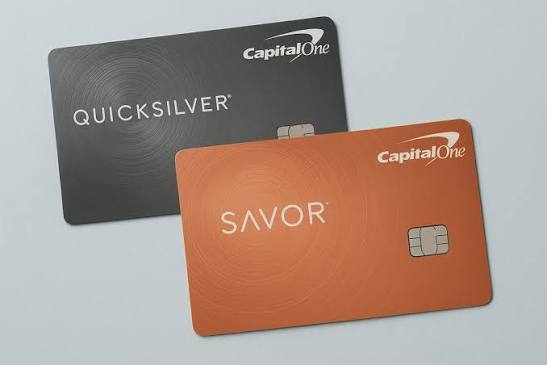
Both cards come from the same Capital One cash back lineup, both skip rotating categories, and both let you redeem rewards for cash, statement credit, or gift cards at any time. But they’re built for two different kinds of spenders and two different credit profiles. Quicksilver is the simple, flat-rate workhorse. SavorOne is the food-and-entertainment specialist that charges a small fee for the privilege.
Here’s exactly how they compare, and the spending level where one clearly beats the other.
Editorial note: We are not financial advisors. This article is for general informational purposes only and does not constitute financial advice. Card terms, rates, and offers are set by the issuer and change frequently always confirm current rates, fees, and terms directly on Capital One’s official site before applying. This post may contain affiliate links; if you apply through one, we may earn a commission at no extra cost to you. That relationship never influences our analysis.
Quick Comparison Table
| Capital One Quicksilver | Capital One SavorOne | |
|---|---|---|
| Annual fee | $0 | $39 |
| Grocery stores* | 1.5% | 3% |
| Dining | 1.5% | 3% |
| Entertainment | 1.5% | 3% |
| Popular streaming services | 1.5% | 3% |
| Capital One Entertainment | 1.5% | 8% |
| Hotels/rental cars via Capital One Travel | 5% | 5% |
| All other purchases | 1.5% | 1% |
| Welcome offer | One-time $200 cash bonus after $500 spent in 3 months | None currently offered |
| Intro APR | 0% on purchases and balance transfers for 15 months | None currently offered |
| Credit needed | Good to excellent | Fair to good |
| Foreign transaction fee | None | None |
*Grocery bonus categories on both cards typically exclude superstores and warehouse clubs like Walmart, Target, and similar big-box retailers confirm the current merchant list before assuming a purchase qualifies.
Capital One Quicksilver: One Flat Rate, Zero Complexity
Quicksilver’s entire pitch is simplicity: 1.5% cash back on every purchase, every day, with no categories to track and no annual fee. On top of the flat rate, it currently offers a one-time $200 cash bonus after spending $500 in the first three months, plus 5% cash back on hotels, vacation rentals, and rental cars booked through Capital One’s own travel portal. There’s also a 0% introductory APR on purchases and balance transfers for 15 months, which can be useful if you’re financing an early large purchase though carrying a balance long-term will typically cost more in interest than any cash back rate can offset.
Because Quicksilver targets good-to-excellent credit, it’s not the easiest Capital One card to get approved for, but it’s a strong pick for anyone who doesn’t want to think about where they’re spending every swipe earns the same rate.
Capital One SavorOne: Higher Rewards for Food and Fun, With a Catch
SavorOne earns unlimited 3% cash back at grocery stores (again, typically excluding superstores), on dining, on entertainment, and on popular streaming services, plus 1% on everything else. It also earns 5% on Capital One Travel hotel and rental car bookings, and 8% on purchases made through Capital One Entertainment.
The catch is twofold: SavorOne carries a $39 annual fee, and it currently offers no welcome bonus and no introductory APR period its entire value proposition rests on the ongoing category rewards. In exchange for the fee, Capital One extends approval to a broader range of credit profiles, including fair credit, which is why SavorOne is often positioned as an entry point into the Capital One ecosystem for people who don’t yet qualify for the no-fee Savor Rewards card built for excellent credit.
The Break-Even Math: When Does SavorOne’s Fee Pay Off?
The comparison comes down to one question: does the extra 1.5 percentage points SavorOne earns on groceries, dining, entertainment, and streaming (3% vs. Quicksilver’s 1.5%) generate more than $39 a year?
To cover the $39 fee, you need roughly $2,600 a year about $217 a month in combined spending across SavorOne’s bonus categories. Below that level, Quicksilver’s no-fee flat rate wins outright, since you’re not paying anything to earn 1.5% everywhere. Above it, SavorOne pulls ahead, and the gap widens the more you spend on groceries, restaurants, and streaming specifically.
A rough real-world example: a single person spending $150 a month on groceries and $100 a month on restaurants and streaming combined ($250/month, $3,000/year) would earn $90 a year on SavorOne’s 3% categories versus $45 a year on Quicksilver’s 1.5% flat rate a $45 gap that comfortably clears the $39 annual fee, netting about $6 more with SavorOne, plus whatever the flat 1% rate earns on other spending. A household spending $500 a month in those same categories would see the gap grow to roughly $180 a year in SavorOne’s favor.
If your monthly spending in groceries, dining, entertainment, and streaming reliably clears somewhere around $220–250, SavorOne is the better long-term earner. If it doesn’t or if it fluctuates a lot Quicksilver’s guaranteed no-fee flat rate is the safer bet.
Which Card Should You Choose?
Pick Quicksilver if:
- You want the simplest possible card with zero annual fee
- Your spending doesn’t concentrate heavily in groceries, dining, or entertainment
- You want a welcome bonus and an intro APR period
- Your credit is good to excellent
Pick SavorOne if:
- Groceries, dining, entertainment, and streaming make up a meaningful share of your monthly budget
- You’re comfortable paying $39 a year in exchange for higher rewards in those categories
- Your credit is fair to good, and Quicksilver or the no-fee Savor card may be a reach for now
For a lot of households, the ideal setup is actually both: SavorOne for food, fun, and streaming, paired with a flat-rate card like Quicksilver for everything that falls outside those categories.
Frequently Asked Questions
Can I upgrade from SavorOne to the no-fee Savor card later? Many Capital One cardholders report being able to product-change to a different card in the lineup as their credit improves, though this isn’t guaranteed and depends on your account history. It’s worth asking Capital One directly once your credit profile strengthens.
Do Quicksilver and SavorOne both exclude Walmart and Target from grocery rewards? Yes, based on current published terms, both cards generally classify superstores and warehouse clubs like Walmart and Target outside the «grocery store» bonus category, so those purchases typically earn the base rate instead. Confirm the current merchant category list on Capital One’s official terms before assuming a specific retailer qualifies.
Which card has a better welcome bonus? Currently, only Quicksilver offers one a one-time $200 cash bonus after $500 in spending within three months. SavorOne does not currently offer a welcome bonus.
Is SavorOne worth it if I have good enough credit for the no-fee Savor card instead? Generally no. If you qualify for Capital One’s no-fee Savor Rewards card (built for excellent credit), it offers the same 3% categories as SavorOne, plus a welcome bonus and intro APR, without the $39 annual fee making it the stronger choice when you’re eligible.
Do either of these cards charge foreign transaction fees? No, neither Quicksilver nor SavorOne currently charges a foreign transaction fee, which makes both usable for purchases made outside the U.S.
Rates, fees, and offers mentioned above reflect terms available as of July 2026 and are subject to change by the issuer at any time. Always verify current rates and fees on Capital One’s official website before applying. This article does not constitute financial, legal, or tax advice.