Best Cash Back Credit Card for Dining in 2026
Last updated: July 2026
Restaurants, takeout, and delivery add up faster than most people realize — federal spending data puts the average U.S. household’s «food away from home» bill at roughly $75 a week, or around $3,900 a year. Put that spending on the right cash back card and you can turn a meaningful chunk of it into real money back, with no points programs or travel redemptions to figure out.
This guide compares the strongest no-annual-fee and low-fee cash back cards for dining specifically, based on their published, ongoing dining rewards rate — not limited-time promotions.
Editorial note: We are not financial advisors. This article is for general informational purposes only and does not constitute financial advice. Card terms, rates, and offers are set by each issuer and change frequently — always confirm current rates, fees, and terms directly on the issuer’s official site before applying. This post may contain affiliate links; if you apply through one, we may earn a commission at no extra cost to you. That relationship never influences our analysis.
Quick Comparison Table
| Card | Dining rate | Other relevant categories | Annual fee | Credit needed |
|---|---|---|---|---|
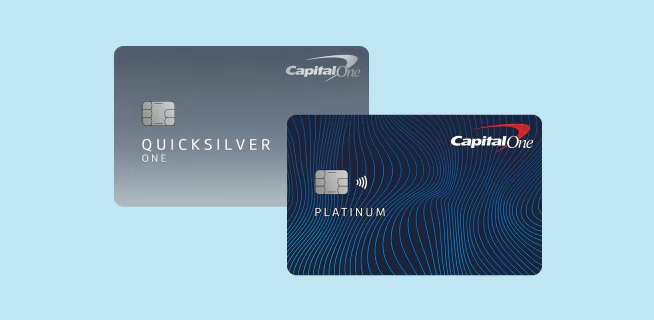
| Capital One Savor | 3% (uncapped) | 3% groceries*, entertainment, streaming; 5% Capital One Travel; 8% Capital One Entertainment | $0 | Excellent |
| Capital One SavorOne | 3% (uncapped) | Same categories as Savor | $39 | Fair to good |
| Chase Freedom Flex | 3% fixed, always-on | 3% drugstores; 5% Chase Travel; 5% rotating quarterly categories (up to $1,500/quarter) | $0 | Good to excellent |
| Chase Freedom Unlimited | 3% fixed, always-on | 3% drugstores; 5% Chase Travel; 1.5% everything else | $0 | Good to excellent |
*Grocery bonus categories typically exclude superstores and warehouse clubs like Walmart, Target, and similar big-box retailers — confirm the current merchant list before assuming a purchase qualifies.
Capital One Savor — Best Overall for Dining
The no-annual-fee Capital One Savor Cash Rewards Credit Card is built around food and entertainment spending: an uncapped 3% cash back on dining, plus the same 3% on groceries, entertainment, and popular streaming services, and 1% on everything else. It also earns 5% on hotels, vacation rentals, and rental cars booked through Capital One Travel, and 8% on Capital One Entertainment purchases.
Because there’s no annual fee, every dollar of dining cash back is pure upside — there’s no break-even math to run. It currently comes with a welcome bonus (recently advertised in the $200–$250 range after spending $500 in the first three months, though exact terms change, so confirm the live offer before applying) and a 0% introductory APR period on purchases and balance transfers.
The card is aimed at applicants with excellent credit, which is the main barrier for some readers — that’s where its lower-tier sibling comes in.
Capital One SavorOne — Same Dining Rate, Easier Approval
SavorOne earns the identical 3% on dining, groceries, entertainment, and streaming as the no-fee Savor card, plus the same 5% on Capital One Travel bookings and 8% on Capital One Entertainment. The difference is a $39 annual fee and a broader approval range that includes fair credit, plus — as of mid-2026 — no welcome bonus and no introductory APR.
If you don’t yet qualify for the no-fee Savor card, SavorOne earns exactly the same ongoing dining rewards while you build toward it. Since both cards share identical category rates, there’s rarely a reason to keep paying SavorOne’s fee once you’re approved for the fee-free version — it’s worth checking your eligibility for an upgrade periodically.
Chase Freedom Flex — Best If You Want Rotating Categories Too
The Chase Freedom Flex earns a fixed 3% cash back on dining at restaurants, including takeout and eligible delivery services, at all times — no activation needed for that rate. On top of that always-on 3%, it layers 3% at drugstores, 5% on travel booked through Chase Travel, and 5% on quarterly rotating categories (on up to $1,500 in combined spending per quarter, after free activation). Chase has run dining itself as a rotating 5% category in some past quarters, which stacks on top of the base 3% for cardholders who activate in time.
One technical note: Freedom Flex technically earns Chase Ultimate Rewards points rather than cash back directly, but those points are redeemable as cash back at a fixed 1-cent-per-point value, so in practice it functions exactly like a cash back card unless you also hold a points-earning Chase card like the Sapphire Preferred, in which case the points can be transferred to airline and hotel partners instead.
This is a strong pick if you want dining rewards plus flexibility to chase other rotating categories throughout the year, and it carries no annual fee.
Chase Freedom Unlimited — Best If You Want Simplicity With Solid Dining Rewards
The Freedom Unlimited earns the same fixed 3% on dining and drugstores, and 5% on Chase Travel, as the Freedom Flex, but replaces the rotating categories with a flat 1.5% on everything else. If you don’t want to remember to activate a new category every quarter, this is the simpler sibling — you get the same dining rate with less maintenance, at the cost of a lower rate on non-bonus spending compared to what Freedom Flex can earn during an active quarter.
A Note on Citi Custom Cash
Citi’s Custom Cash card — which earned 5% on your single top spending category each billing cycle, including dining, up to a monthly cap — has been a popular pick in past dining comparisons. As of May 2026, Citi is no longer accepting new applications for this product, so it’s not currently an option for new applicants, even though it may still appear in older articles and comparison tools. If you already hold the card, it should continue operating under its existing terms; check with Citi directly for the latest status.
Which Card Should You Choose?
Pick Capital One Savor if: you qualify for excellent credit and want the highest uncapped dining rate with zero annual fee and zero complexity.
Pick Capital One SavorOne if: you want the same dining rewards but your credit isn’t quite at excellent yet, and you’re comfortable with a modest $39 fee in the meantime.
Pick Chase Freedom Flex if: you want a fixed 3% dining rate but also enjoy chasing rotating 5% categories for extra value throughout the year.
Pick Chase Freedom Unlimited if: you want the same fixed 3% dining rate as Freedom Flex, but prefer a flat rate on everything else with nothing to activate.
For heavy diners who also spend a lot on travel, pairing one of these with a card like the Chase Sapphire Preferred (a points card, not pure cash back) can multiply value further — but for cash back purposes alone, Capital One Savor’s uncapped 3% with no fee is the benchmark the others are measured against.
Frequently Asked Questions
Does «dining» include takeout and food delivery apps, or only sit-down restaurants? On the cards covered here, the dining category generally includes takeout and eligible delivery services in addition to traditional restaurants, based on current issuer terms. Coverage of specific delivery platforms can vary, so confirm with the issuer if a particular app is central to your spending.
Is there a cap on the 3% dining rate on Capital One Savor or SavorOne? No, based on current published terms, the 3% dining rate on both cards is uncapped and does not expire, as long as the account remains open and in good standing.
Do coffee shops and fast food count as dining? Generally yes — most issuers classify quick-service restaurants, cafes, and fast food under the same merchant category codes as traditional restaurants, though this is ultimately determined by how the merchant itself is coded, which is outside the cardholder’s control.
Is it worth paying an annual fee just for dining rewards? Usually only if the fee is small and your dining spend is consistent. In this comparison, SavorOne’s $39 fee only makes sense if you don’t yet qualify for the identical no-fee Savor card — there’s rarely a reason to pay a fee for the exact same rewards you could get for free elsewhere.
Can I combine a dining-focused cash back card with a groceries or gas card? Yes, this is a common strategy — many cardholders carry one card optimized for dining and entertainment alongside a separate card optimized for groceries or gas, since few single cards maximize every category at once.
Rates, fees, and offers mentioned above reflect terms available as of July 2026 and are subject to change by each issuer at any time. Always verify current rates and fees on the issuer’s official website before applying. This article does not constitute financial, legal, or tax advice.